Project: Sugar Magnolia
Role: Lighting & Smart Home Designer
Overview#
Sugar Magnolia is a lighting and smart home design for a three-story property being converted into a short-term rental. The engagement covered power architecture, rail planning, power injection, networking, and integration with Home Assistant — spanning power engineering, home automation architecture, and device selection. Deliverables included a full lighting specification and a series of design recommendations covering hub hardware, voice ecosystem, and sensor integration.
Challenges and Objectives#
Power Distribution: Deliver 184A worth of 24V DC, distributed throughout 3 stories of a property under renovation.
Data and Signal Architecture: Route data to every LED run alongside ground, maintaining signal integrity without differential signalling.
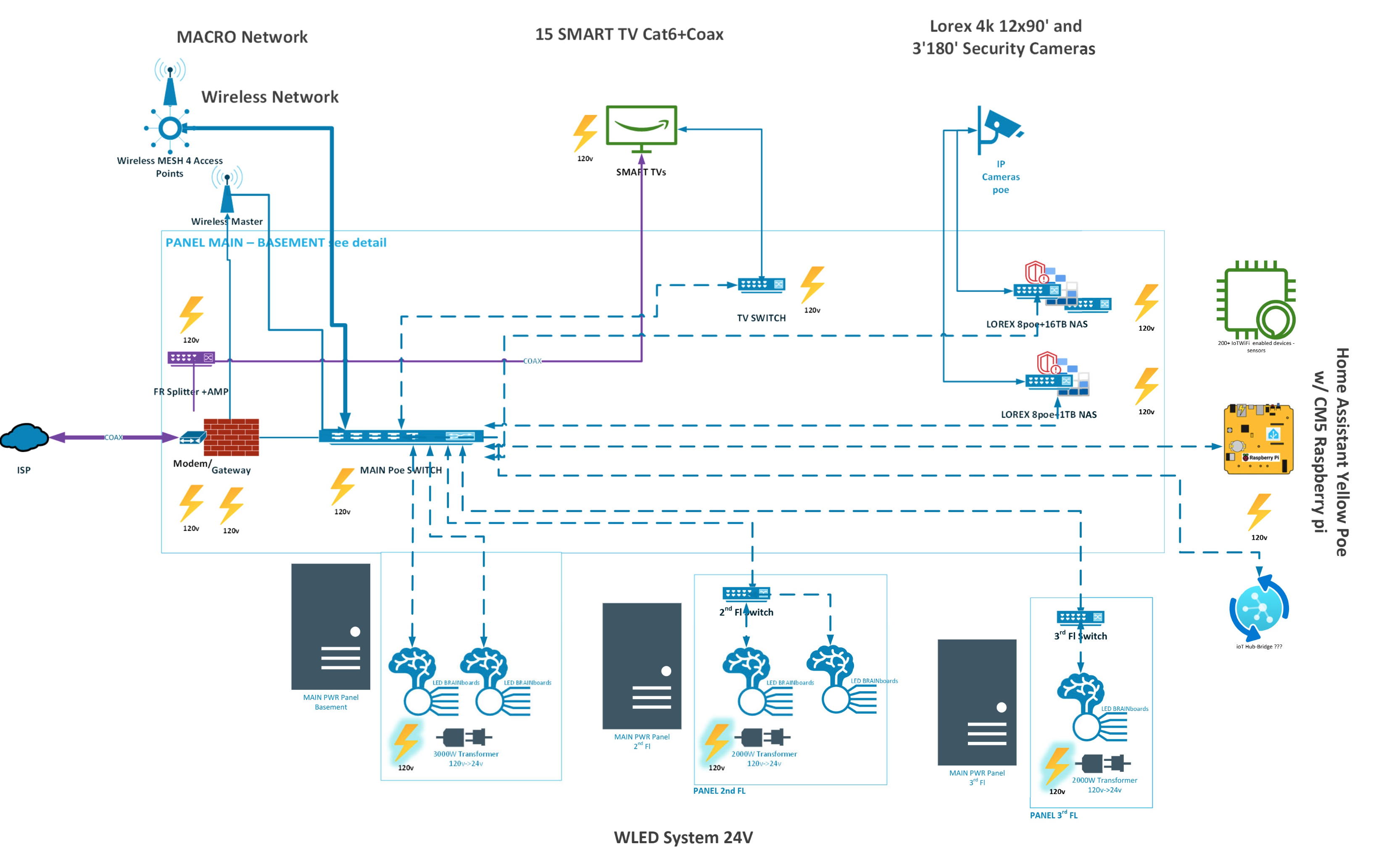
Sensor Integration: Integrate cameras, doors, presence, water, temperature/humidity, and decibel sensing across three floors and outdoors, with every device feeding Home Assistant directly.
Human Interface Design: Give guests control over lighting, music, and the broader system without formal introduction.
My Contributions#
1. Power Architecture#
- Evaluated three delivery options: a single 24V supply for the whole property, one per floor, or distributed smaller adapters. The single-supply approach required an impractical wire gauge, so each floor received its own 100A 24V supply.
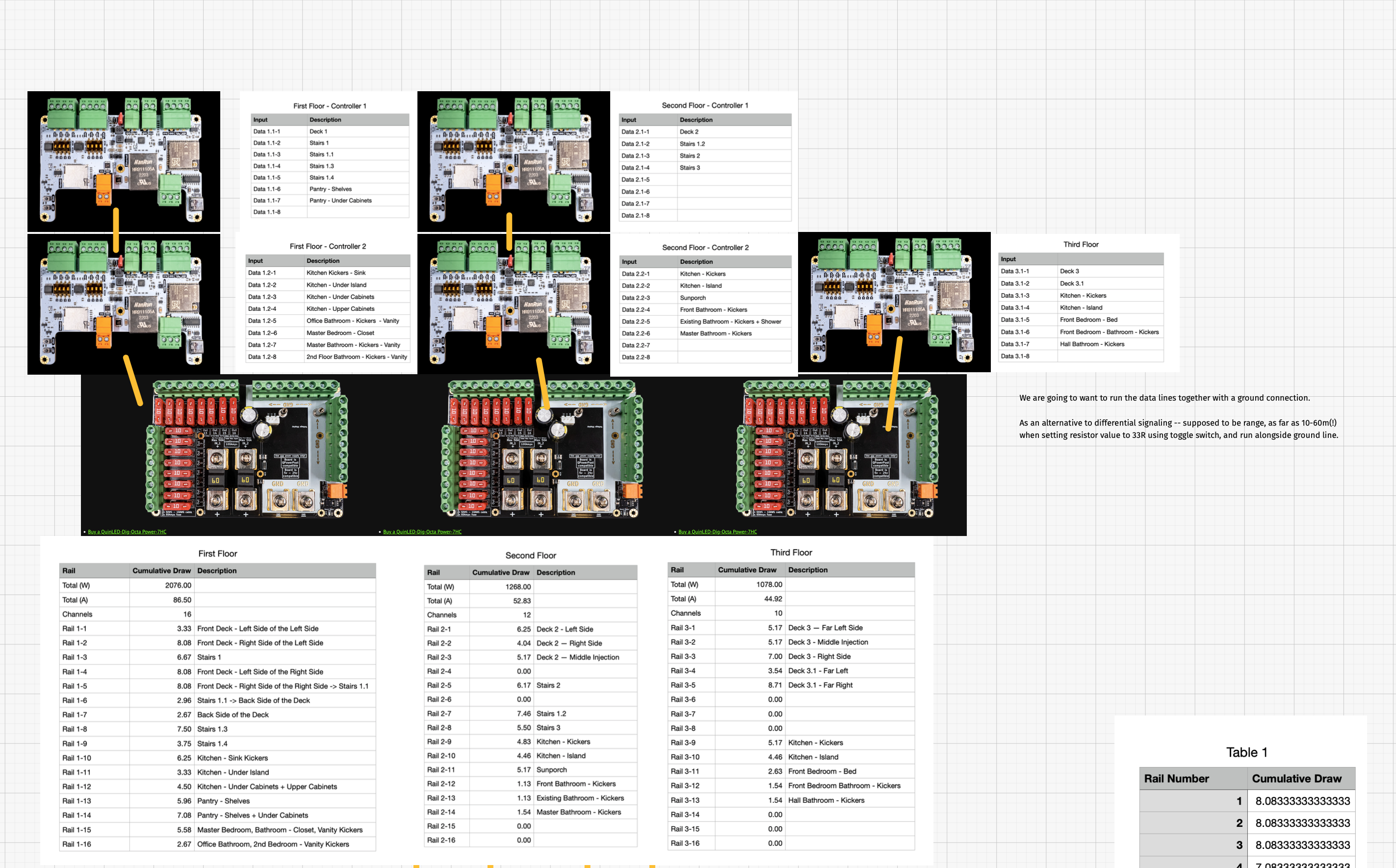
- Sized supplies against measured load: 184A and 4.4kW total across three floors, distributed as 86.5A on the first, 52.8A on the second, and 44.9A on the third.
- Each 100A supply feeds a 16-channel distribution board, with each rail capped and fused at 10A — both for safety and to match the heaviest-duty commercial power/driver boards available. Only the first floor populates all 16 channels.
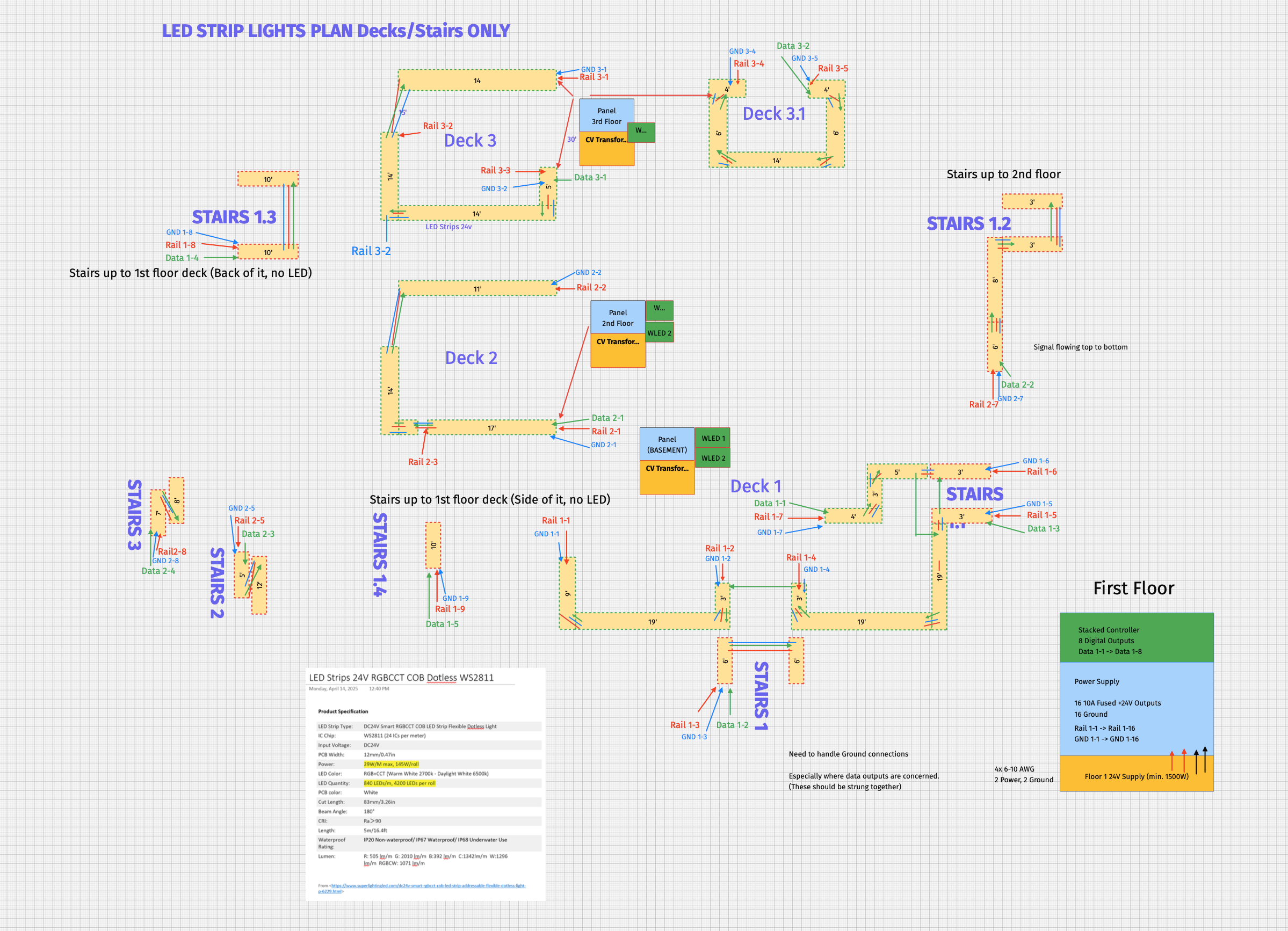
- Specified power injection points for every LED run across all three floors.
2. Data and Signal Distribution#
- Assigned each rail to a controller output across five controllers, distributing two on the first floor, two on the second, and one on the third, with each run traced back to its physical layout.
- Signal routing followed power. Per-floor supplies forced per-floor controllers to maintain a common ground reference, which shortened data runs enough to avoid differential signalling.
3. System Integration and Validation#
- Specified Home Assistant as the hub for all inputs and outputs.
- Selected hub hardware: Raspberry Pi CM5 with Home Assistant Yellow, sized with headroom for extensions.
- Screened candidate sensors across all six categories. Many failed: reachable only through proprietary controllers, SaaS subscriptions, or third-party apps.
- Mapped control surfaces to outputs, so sensor state, schedule, and manual input could each trigger lighting behaviour.
4. Voice and Interface Selection#
- Compared Apple, Google, and Amazon as voice ecosystems for a hospitality setting, favouring compatibility with guest devices.
- Evaluated Echo hardware across price, ultrasonic vs camera-based motion sensing, and Home Assistant interoperability, ruling out devices whose motion data required auxiliary sensors. Account isolation was a secondary constraint.
- Specified wall-mounted iPads running the native Home Assistant client as per-floor dashboards.
- Explored a PWA hosted on a domain and reached via QR code in each suite, delivering guest-specific functionality without native app development.
Outcomes and Results#
- Complete Lighting Specification: Every run across three floors itemized and assigned — power, data, and injection points.
- Power Architecture Resolved: 300A of 24V DC supply current across three floors, against a measured 184A / 4.4kW draw.
- System Architecture Defined: Home Assistant as the hub, with sensor inputs and LED outputs mapped.
- Deliverables Handed Off: Lighting specification and design recommendations provided to the client for installation.
Technical Summary#
- Skills: Power System Design, Load Calculations, Rail Planning, Home Automation Architecture
- Tools & Components:
- Controller: QuinLED Dig-Octa Brainboard 32-8L
- Distribution: QuinLED Dig-Octa Power-7HC
- Power Supply:
- Meanwell RSP-3000-24 (24V, 125A, 3000W)
- Meanwell RSP-2000-24 (24V, 80A, 1920W)
- LEDs: DC24V RGBCCT COB LED Strip WS2811 (24 ICs per meter)
- Firmware: WLED
- Hub: Raspberry Pi CM5 with Home Assistant Yellow
- Features: Sensor-to-light mapping, multi-controller data architecture, per-floor power distribution, 48 provisioned rails, per-run power injection,
Gallery#